

Phoenix is becoming more than a fast-growing city. It is developing into a major business hub where technology, advanced manufacturing, healthcare innovation, and professional services increasingly overlap. The City of Phoenix Economic Development and Education Strategic Plan identifies emerging technology, manufacturing, producer services, and bioscience among the city’s key economic priorities. The city also continues to focus on attracting and retaining businesses in technology, finance and business services, and life sciences. That growth creates a communication challenge.
As organizations become more sophisticated, their communication needs become more complicated, too. A technology company may have developers, sales teams, implementation specialists, and remote employees working across locations. A manufacturer may need to coordinate office staff, suppliers, technicians, production teams, and customers. A healthcare organization has to balance accessibility with privacy and operational requirements. Professional services firms may have consultants, attorneys, accountants, engineers, and advisors managing multiple client relationships at once. In all of these environments, communication is part of the infrastructure that keeps the business moving.
Phoenix Is Building a More Connected Business Ecosystem
The scale of Phoenix’s technology and manufacturing growth illustrates why communication is becoming increasingly important. In July 2026, TSMC announced an additional $100 billion investment in Arizona, bringing its total planned investment in the state to $265 billion. According to the City of Phoenix announcement, the expansion includes four additional advanced fabs and is expected to further develop the semiconductor ecosystem in the region. TSMC’s expansion is part of a much larger manufacturing network. Suppliers, equipment companies, engineering firms, logistics providers, technology companies, and professional services organizations all play roles in supporting advanced manufacturing. Phoenix is also expanding its healthcare and bioscience ecosystem.
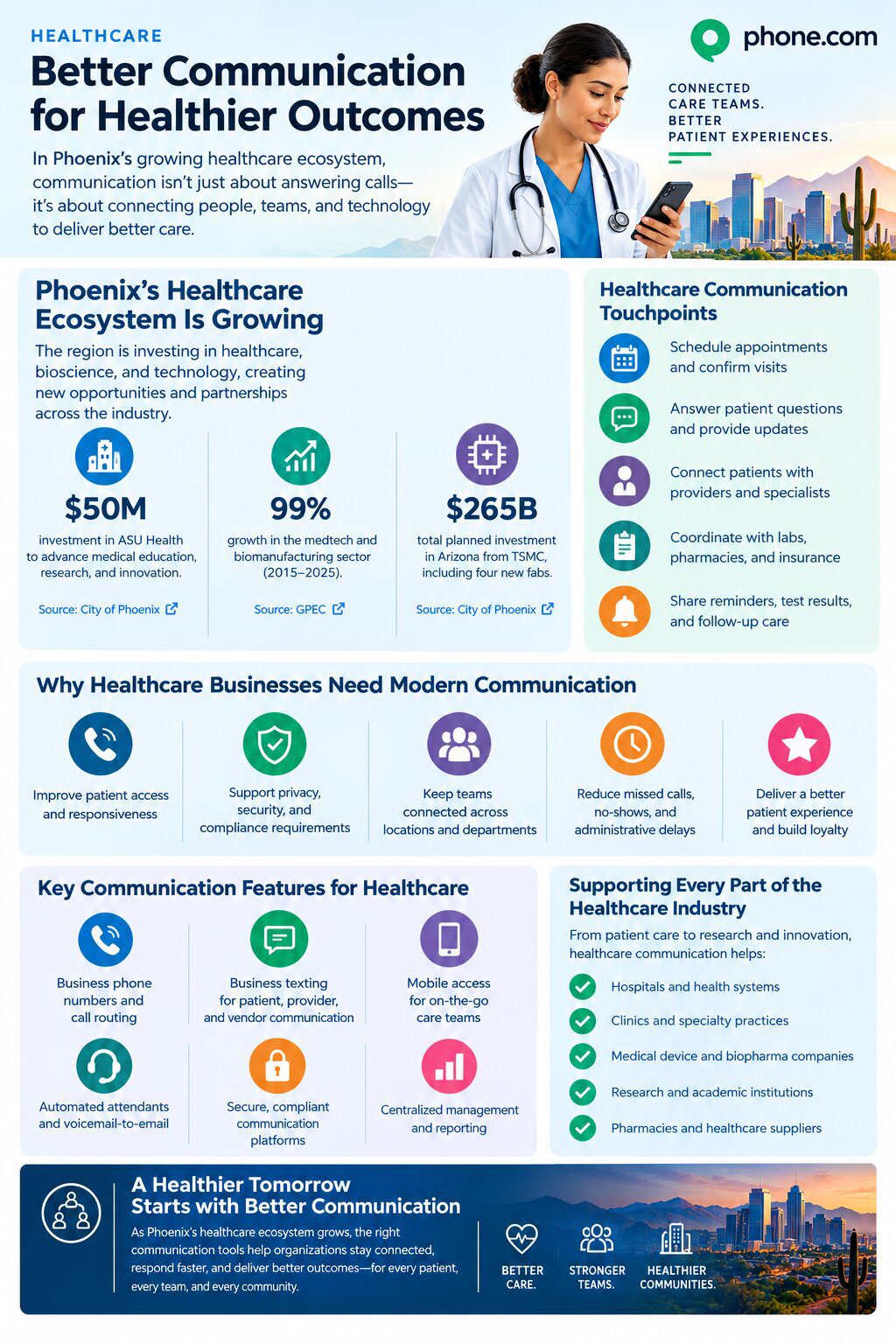
In March 2026, Phoenix approved a $50 million investment in ASU Health, supporting the development of the John Shufeldt School of Medicine and Medical Engineering in the Phoenix Bioscience Core. The City of Phoenix’s announcement describes the project as bringing medicine, engineering, and technology together while supporting medical research and healthcare education. Greater Phoenix’s broader healthcare ecosystem is growing as well. According to the Greater Phoenix Economic Council’s 2026 overview of biosciences and healthcare innovation, employment in the region’s medtech and biomanufacturing sector grew 99% from 2015 to 2025. These developments create networks of companies that depend on one another. And those companies need reliable ways to communicate.

Technology Companies Need Communication That Moves as Quickly as They Do
Phoenix’s technology ecosystem includes software companies, semiconductor businesses, cybersecurity organizations, data centers, startups, and technology-enabled businesses. These companies often operate differently from traditional offices. Employees may work remotely. Teams may be distributed across locations. Customers may interact with sales, support, implementation, and technical teams at different stages of the relationship. That makes a traditional office phone sitting on someone’s desk less useful. A modern business communication system can give employees access to the same business number and communication tools whether they are working from an office, home, customer site, or another location.
For Phoenix technology companies, that can mean:
- Routing calls to the appropriate employee or department
- Giving remote employees access to business calls
- Using business texting for appropriate customer communication
- Connecting callers with sales or technical support
- Maintaining a consistent business identity across locations
- Supporting communication between distributed teams
- Managing communications through a centralized platform
The goal isn’t simply to answer more calls. It’s to make sure the right person can respond when a customer, prospect, partner, or employee needs them.

Advanced Manufacturing Requires Communication Beyond the Factory Floor
Phoenix’s advanced manufacturing growth is particularly significant. The Greater Phoenix Economic Council’s advanced manufacturing overview describes the region as having one of the largest manufacturing supply-chain ecosystems in the country. Semiconductor manufacturing is one of the most visible examples. TSMC’s July 2026 expansion announcement says its Arizona operations already employ more than 3,500 people and that its planned fabs will support a growing leading-edge semiconductor manufacturing cluster. But a manufacturing ecosystem is about more than the manufacturer itself.
Companies may need communication between:
- Production and administrative teams
- Suppliers and purchasing departments
- Engineers and technicians
- Sales and operations
- Customers and account managers
- Field service employees and headquarters
- Vendors and facilities teams
A missed call from a supplier isn’t necessarily just an inconvenience. It could delay a shipment, interrupt a project, or require someone to spend time tracking down the right employee. Call routing, business texting, shared numbers, and mobile access can help manufacturers create clearer communication paths without making every employee responsible for monitoring a single phone line.
Healthcare Communication Has Higher Stakes
Healthcare organizations face another layer of complexity. Patients may call to schedule appointments, confirm information, ask questions, reach a provider, or follow up after a visit. Staff members may also communicate with specialists, laboratories, pharmacies, insurance organizations, vendors, and other healthcare professionals. Phoenix is investing heavily in the intersection of healthcare, engineering, and technology.
The City of Phoenix’s 2026 ASU Health announcement notes that ASU Health’s new medical school will combine clinical medicine, biomedical science, and engineering. The region’s healthcare growth extends beyond traditional care delivery. The Greater Phoenix Economic Council’s healthcare and bioscience research highlights areas including medical devices, wearable technology, biomanufacturing, and health innovation. For healthcare businesses, communication technology should therefore support accessibility without creating unnecessary complexity.
Depending on the organization’s needs and compliance requirements, businesses may evaluate capabilities such as:
- Dedicated business numbers
- Call routing and extensions
- Automated attendants
- Business texting
- Mobile access for authorized employees
- Administrative controls
- Call management and reporting
- Integrations with other business systems
For organizations handling protected health information, communication platforms should be evaluated against the organization’s specific privacy, security, and compliance requirements.
Professional Services Depend on Responsiveness
Phoenix’s growth isn’t limited to companies producing physical products. The city also identifies producer services and business services as important parts of its economic development strategy. Professional services can include accounting, legal services, consulting, engineering, financial services, marketing, technology consulting, and other organizations that support businesses and their customers. For these companies, responsiveness can be part of the product.
Consider an accounting firm during tax season, a law firm working toward a deadline, an engineering consultancy managing a major project, or a business consultant coordinating multiple client engagements. Clients aren’t necessarily expecting someone to answer every call immediately. They are expecting the business to have a reliable process for responding. A professional services firm can use call routing, voicemail-to-email, business texting, shared numbers, and other communication tools to create a more predictable client experience without requiring every employee to be permanently available.
Business Texting Can Keep Conversations Moving
Phone calls aren’t the only communication channel customers and clients use anymore. Texting can be useful when a full phone conversation isn’t necessary.
A Phoenix business might use business texting to:
- Confirm an appointment
- Notify a customer that a technician is on the way
- Follow up after a sales conversation
- Confirm a meeting time
- Provide a project update
- Remind a client about a scheduled consultation
- Coordinate with a vendor
- Request information needed to complete a project
For technology and professional services companies, texting can keep a conversation moving between meetings. For healthcare organizations, it can support appropriate administrative communications when implemented within the organization’s privacy and compliance requirements. For manufacturers, it can provide another channel for communicating with customers, vendors, or field personnel. The important distinction is using a business communication channel rather than relying on employees’ personal phone numbers.
Personal Cell Phones Can Create a Business Problem
When a company grows quickly, employees often start using whatever communication method is immediately available. That can mean a personal cellphone. It may work temporarily, but it creates problems as the organization becomes more complex. Customers may save an employee’s personal number instead of the company’s main number. Employees may struggle to separate work and personal communications. If someone leaves the company, customers may continue contacting them directly.
A dedicated business number helps establish a clearer boundary. It also gives the organization greater control over how calls and messages are handled. If an employee is unavailable, calls can potentially be routed elsewhere. If someone changes roles, communication can be redirected without requiring customers to learn an entirely new number. That becomes increasingly valuable as Phoenix companies expand.
Growth Makes Communication Infrastructure More Important
One of the less obvious challenges of rapid growth is that communication systems don’t always grow at the same pace. A company may start with five employees and one main number.
Then it adds:
- A second location
- A sales team
- Customer support
- Field employees
- Remote workers
- New departments
- Additional phone numbers
- More vendors
- More customers
Suddenly, the communication system that worked for a small team becomes difficult to manage.
Phoenix’s economic development strategy specifically emphasizes attracting and retaining technology, manufacturing, business services, and bioscience companies. The City of Phoenix’s economic development strategy also calls for supporting the growth of small and medium-sized businesses in areas including innovation, technology, finance/business services, and biosciences. For companies operating in these sectors, communication infrastructure should be considered part of the broader growth strategy, not something added only after problems appear.
Phoenix Businesses Also Need to Communicate Across Industries
One of the most interesting aspects of Phoenix’s economic development is how closely these industries can overlap. Advanced manufacturing supports healthcare technology. Semiconductors support artificial intelligence, medical devices, and other technology. Technology companies support professional services. Healthcare organizations work with technology vendors, consultants, manufacturers, and research organizations. Professional services firms help growing companies navigate legal, financial, engineering, staffing, marketing, and operational challenges.
The City of Phoenix’s 2026 economic overview describes workforce initiatives aligned with high-demand industries, including advanced manufacturing training developed with partners such as TSMC, community colleges, and other organizations. That interconnectedness means a business may technically operate in one industry while communicating constantly with companies in several others. A medical-device manufacturer might need to coordinate with a healthcare provider, engineering firm, technology vendor, and logistics company. A software company might work with a semiconductor manufacturer and a professional services firm. The ability to communicate across those relationships becomes a part of how efficiently the business operates.
What Should Phoenix Businesses Look for in a Communication System?
The right setup depends on the organization, but Phoenix businesses in these industries may want to evaluate whether their communication platform provides:
Business numbers: Employees can communicate professionally without relying on personal numbers.
Call routing: Calls can reach the appropriate person or department instead of depending on one employee to answer everything.
Mobile access: Employees who work remotely or in the field can still communicate through the business system.
Business texting: Teams can use messaging for appropriate customer, client, vendor, and operational communications.
Scalability: Adding employees, departments, locations, or numbers doesn’t require rebuilding the entire system.
Centralized management: Administrators have greater visibility and control over business communications.
Professional customer experience: Customers receive a consistent experience whether they call the main number, reach an employee directly, or communicate through another channel.
The goal isn’t to add technology simply because technology is available. It’s to remove communication friction.
Related Post:Business Phone System Checklist
Phoenix’s Next Phase of Growth Will Require Connected Businesses
Phoenix is building an economy where technology, manufacturing, healthcare, and professional services increasingly overlap. The region’s semiconductor investments are creating new supplier relationships. Healthcare and bioscience are bringing medicine, engineering, research, and technology together. Technology companies are building products and services that support other industries. Professional services firms are helping organizations navigate the complexity that comes with growth.
The Arizona Commerce Authority’s FY2026 economic development report reported that Arizona companies committed to more than $109 billion in investment and 26,225 projected new jobs during fiscal year 2026, with Phoenix among the communities receiving expansion projects. For businesses operating in this environment, communication isn’t simply about answering the phone.
It’s about making sure opportunities, questions, projects, appointments, and relationships don’t get stuck because someone couldn’t reach the right person.
As Phoenix continues to attract investment and build out its technology, manufacturing, healthcare, and professional services ecosystems, businesses that treat communication as part of their infrastructure can build systems capable of supporting the people who depend on them every day.
Frequently Asked Questions
What industries are growing in Phoenix?
Phoenix’s economic development strategy identifies technology, manufacturing, producer services, and bioscience among its priority sectors. The region is also experiencing significant semiconductor, healthcare, and advanced manufacturing investment.
Why do Phoenix technology companies need business communication tools?
Technology companies often have remote employees, distributed teams, technical support functions, and customers who need access to different departments. Business communication tools can help companies route calls, support mobile employees, manage business numbers, and maintain consistent customer communications.
How can communication technology help Phoenix manufacturers?
Manufacturers can use business communication systems to connect office teams, production personnel, suppliers, customers, engineers, and field employees. Call routing, business texting, mobile access, and centralized administration can help reduce communication bottlenecks.
What communication challenges do healthcare businesses face?
Healthcare organizations may need to manage patient calls, appointment communications, provider access, administrative requests, and communications with outside organizations. Their technology choices should account for applicable privacy, security, and regulatory requirements.
Can professional services firms use business texting?
Yes. Professional services businesses can use business texting for appropriate appointment confirmations, meeting coordination, follow-ups, status updates, and other client communications, subject to their industry and organizational requirements.
Why should a growing Phoenix business use a dedicated business phone number?
A dedicated business number separates company communications from employees’ personal numbers and gives the organization greater control over call routing, employee access, departments, and future growth.
Final Thoughts
Phoenix is building an economy where technology, advanced manufacturing, healthcare, and professional services increasingly intersect.
That makes communication more than an administrative function. It is part of how businesses coordinate people, respond to customers, manage relationships, and keep work moving.
Whether the business is manufacturing advanced components, developing technology, providing healthcare, or advising other companies, the underlying need is similar:
When someone needs to reach the business, the business needs a reliable way to respond.
For Phoenix companies preparing for their next stage of growth, modernizing business communication can be one practical way to build a more connected organization—without making communication more complicated than it needs to be.