
 Cryptography phones—more commonly called secure or encrypted phones—are the latest chapter in a much older effort to keep information private. Long before smartphones, people were disguising military orders, diplomatic messages, and trade secrets so only the intended recipient could understand them.
What changed over time was not the basic goal, but the technology. Handwritten ciphers gave way to machines, mathematical algorithms, secure telephone terminals, encrypted mobile networks, and finally smartphones capable of protecting communications and cryptographic keys in dedicated hardware.
Key takeaways
- Cryptography evolved from ancient ciphers and mechanical systems into the mathematical algorithms that secure modern digital communication.
- Secure telephony began largely as a government and military technology before encryption became widely available on consumer mobile devices.
- Early mobile security relied on network-level encryption, while modern smartphones add hardware-backed protection, biometrics, and end-to-end encrypted apps.
- Debates over government access to encrypted communications, including the Clipper chip controversy, helped shape modern privacy and security policy.
- Today’s crypto phones extend secure mobile technology to blockchain use, protecting private keys, digital assets, and Web3 transactions.
What is cryptography?
Cryptography is the practice of protecting information by transforming it into a form that unauthorized parties cannot easily understand. Modern systems typically use algorithms and cryptographic keys to encrypt data and then decrypt it for an authorized recipient.
Cryptography also supports more than secrecy. Digital signatures, authentication, and integrity checks can help confirm who sent information and whether it was altered. Those capabilities now underpin secure websites, private messaging, banking, software updates, and mobile communications.
- Introduction to Cryptography
- Cryptography and Its Types
- Goals of Cryptography
- Difference Between Encryption and Digital Signatures
- What Is Encryption
Pre-20th century cryptography
 Some of the earliest known cryptographic techniques were simple by modern standards but established ideas that still matter today: hide the meaning of a message and control who can recover it.
Ancient Spartans used the scytale, a device that rearranged a message written on a strip wrapped around a cylinder. Julius Caesar is associated with a substitution cipher that shifted letters through the alphabet. Centuries later, Arab scholar Al-Kindi described frequency analysis, showing that ciphers could be attacked by studying how often letters or symbols appeared.
Renaissance cryptographers made substitution systems more complex through polyalphabetic ciphers, which changed the relationship between plaintext and ciphertext throughout a message.
That ongoing contest between stronger encryption and better cryptanalysis became a defining feature of cryptographic history.
- Classical Cyphers
- Renaissance Cryptography
- Vigenère Cipher
- Classical Cryptography and Frequency Analysis
- Ciphers: Lost Languages and Unreadable Technologies
20th-century cryptography and the world wars
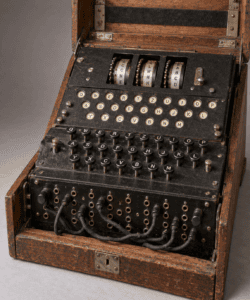 The 20th century moved cryptography from paper-and-pencil techniques toward electromechanical machines.
Germany’s Enigma machine became the best-known example. Polish mathematicians, including Marian Rejewski, made crucial breakthroughs against Enigma before World War II and shared their work with Britain and France. British teams at Bletchley Park, including Alan Turing, then expanded those efforts during the war.
These developments showed how cryptography, communications technology, mathematics, and computing were becoming inseparable. They also accelerated the development of machines designed specifically to process encrypted communications.
- Breaking the Enigma Cipher
- Alan Turing and Bletchley Park
- Women Codebreakers During World War II
- Colossus: Breaking the Code
- The Zimmermann Telegram
The rise of modern cryptography
As computers became widespread, encryption shifted toward standardized mathematical algorithms.
The U.S. adopted the Data Encryption Standard (DES) in 1977, but its 56-bit key eventually became too vulnerable to exhaustive search as computing power increased. NIST selected Rijndael as the basis for the Advanced Encryption Standard (AES), formally standardized in 2001.
Public-key cryptography also transformed secure communication by allowing parties to establish secure communications without first sharing the same secret key.
Technologies such as Diffie-Hellman and RSA helped make encryption and digital signatures practical across open networks. These concepts became foundational to web security, secure email, virtual private networks, and eventually mobile applications.
- Cryptography and Communication Security in a Digital Age
- Strengthening Cryptographic Standards and Validation
- Public-key Encryption
- The RSA Cryptosystem
- How Encryption and Modern Cryptography is Shaping Our Digital Lives
Evolution of cryptographic phones
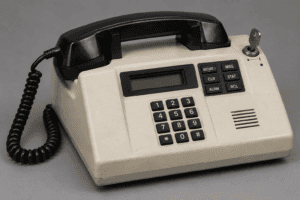 Secure communication gradually moved from dedicated government terminals to mobile networks, hardened smartphones, and consumer encryption apps for even regular phones. Each stage added new layers of protection, from encrypted voice traffic to hardware-isolated key storage and end-to-end encrypted messaging.
Government-Restricted Beginnings (1990s)
The STU-III and Early Secure Terminals
The STU-III, developed in the 1980s and widely used into the 1990s, was an early secure telephone system designed for U.S. government and military communications. Unlike consumer phones, it was purpose-built for encrypted voice calls and remained largely restricted to organizations handling sensitive or classified information.
The Clipper Chip Controversy (1993)
In 1993, the U.S. government proposed the Clipper chip as a way to bring strong encryption to telecommunications while preserving government access. It used the classified Skipjack algorithm and a key-escrow system that allowed authorized agencies to obtain decryption keys, prompting widespread debate over privacy, surveillance, and government access to encrypted communications.
Hardware and Network Evolution (2000s–2010s)
Cellular Network Encryption (2G)
 Second-generation GSM networks introduced encryption for over-the-air mobile communication using ciphers such as A5/1. A weaker export-oriented version, A5/2, was also deployed, but researchers later demonstrated serious vulnerabilities in these systems, showing that network-level encryption alone could not guarantee secure mobile communication.
Enterprise and Hardware Security (2008–2013)
As smartphones became business tools, security expanded beyond the mobile network. Exchange ActiveSync supported controls such as password policies and remote wipe, while technologies such as Arm TrustZone created isolated environments for sensitive operations. Samsung later introduced Knox in 2013, combining hardware-backed security with enterprise device management.
Niche Cipher Phones
Specialized cipher phones also emerged for users requiring stronger privacy than standard consumer phones could provide. These hardened or modified handsets could limit features such as cameras, location services, or unnecessary applications while adding encrypted calls and messaging, secure storage, and remote-wipe capabilities.
Mainstream and Web3 Era (Present)
End-to-End Encryption Standards
Secure mobile communication is now widely accessible through mainstream smartphones and encrypted apps. Modern devices combine end-to-end encrypted messaging and calls with biometric authentication, secure operating-system controls, and hardware-backed key storage, bringing capabilities once reserved for specialist systems to everyday users.
The Rise of Crypto Phones
More recently, crypto phones have extended mobile security into blockchain applications. These devices may include built-in cryptocurrency wallets, hardware-isolated storage for private keys, and native support for Web3 services and decentralized applications, shifting the secure-phone concept from protecting conversations alone to protecting digital identities, transactions, and assets.
From the Spartan scytale to secure smartphones, the tools used to protect communication have changed dramatically, but the goal has stayed the same: keep sensitive information in the right hands. Today, encryption can protect calls, messages, and digital assets in ways earlier generations could scarcely imagine. Understanding how those protections evolved can help businesses ask better questions about the tools they use every day.