
How faster, more dependable communication helps small businesses earn trust, win opportunities, and strengthen customer relationships.
Key Takeaways
- Customers often interpret response time as a sign of how reliable, organized, and attentive a business will be.
- A prompt acknowledgment can reduce uncertainty and build trust, even when the customer’s request cannot be resolved immediately.
- Slow responses and missed calls give prospective customers more time—and more reason—to choose a competitor.
- Response speed is especially important in time-sensitive industries such as home services, healthcare, legal services, and real estate.
- Call routing, business texting, mobile business lines, live receptionists, and AI-powered call answering can help small businesses respond faster without placing more pressure on their teams.
- Improving responsiveness starts with clear standards, assigned ownership, and a consistent follow-up process—not technology alone.
Trust Begins Before the First Conversation
A prospective customer may never meet your team, visit your office, or experience your service if no one responds when they reach out. For many people, the first impression of a business is not created in person. It happens through a phone call, text message, web form, or email—and it can be shaped in a matter of seconds.
Customers notice how quickly a business answers and how clearly it communicates. A prompt response signals that the company is attentive, organized, and prepared to help. A long silence can suggest the opposite, even when the delay has an innocent explanation.
That is the hidden link between response time and customer trust: responsiveness becomes evidence. Before customers know whether your work is excellent, they use your availability to judge whether you are likely to be reliable.
Why Response Time Matters More Than Ever
Smartphones have made information and communication nearly instantaneous. Customers can compare options, read reviews, request quotes, and contact several businesses from the same screen. A delay that once seemed normal can now feel out of step with everyday customer expectations.
This does not mean every small business must have a large contact center or provide an immediate, detailed solution to every question. It does mean customers increasingly expect quick acknowledgment and a clear next step. A simple response—“We received your message and will call you by 3 p.m.”—can reduce uncertainty and show that someone is paying attention.
Response Time Is an Availability Signal
When a prospective customer reaches out, they are often evaluating more than the answer to a specific question. They are also asking:
Will this company be easy to work with?
Can I count on this team when I need help?
Will someone respond if something goes wrong?
Because the customer has limited information, response time becomes a proxy for reliability. Fast, useful communication cannot prove that every future interaction will be perfect, but it gives the customer an early reason to feel confident.
The Psychology Behind Fast Responses
Waiting creates uncertainty. A customer who has asked for an estimate, requested an appointment, or reported a problem does not know whether the message was received, whether help is available, or when to expect an answer. As that uncertainty grows, so can anxiety and doubt.
A timely response closes that information gap. It tells the customer: we see you, your request matters, and there is a process in place. That acknowledgment can be especially important when the customer is making a significant purchase or dealing with an urgent need.
Silence, by contrast, invites customers to fill in the blanks. They may wonder whether the business is disorganized, whether their business is valued, or whether future support will be difficult. The longer they wait, the easier it becomes to keep searching.
What the Research Says About Customer Expectations
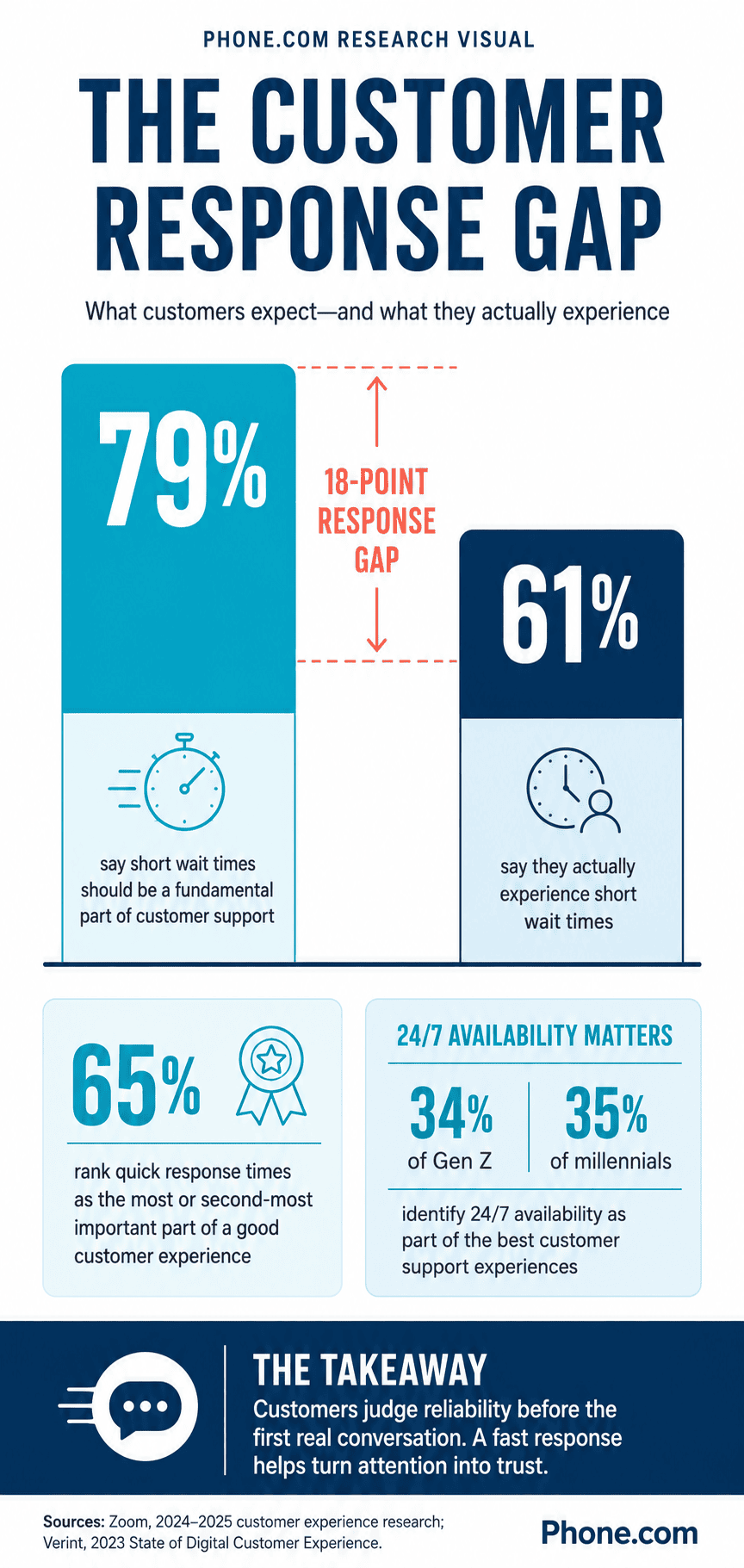
The emphasis customers place on speed is not just anecdotal. In Verint’s 2023 research, 65% of surveyed consumers ranked quick response times as the most or second-most important part of a good customer experience.
More recent research summarized by Zoom found a striking expectations gap: 79% of consumers said short wait times should be a fundamental part of support, while only 61% said they actually experienced them. The same source reports that 34% of Gen Z consumers and 35% of millennials identify 24/7 availability as an attribute of the best support experiences.
Speed also matters when a customer is still deciding where to buy. Harvard Business Review’s The Short Life of Online Sales Leads examined how slowly many organizations followed up on internet-generated leads. The lesson remains relevant for small businesses: interest is time-sensitive. A prospect who is ready to talk today may be speaking with a competitor tomorrow—or in the next few minutes.
Missed Calls Can Quickly Become Missed Opportunities
Phone inquiries are particularly time-sensitive because a call often reflects immediate intent. The caller may need a plumber for a leak, a same-week legal consultation, an appointment, or an answer before making a purchase. If the call is not answered, some people will leave a voicemail. Others will simply call the next business on the list.
The first business to respond does not automatically win. The response must still be relevant, professional, and helpful. But being first creates an important advantage: the business has an opportunity to understand the need, reduce uncertainty, and begin earning trust before competitors enter the conversation.
How Slow Responses Erode Customer Trust
One delayed reply may be forgiven. A pattern of slow or inconsistent communication becomes part of the customer experience. Over time, it can affect far more than one interaction.
Lost revenue
Every unanswered inquiry gives the customer time—and motivation—to consider another provider. The effect is easy to underestimate because the business may never know how many prospects moved on without identifying themselves.
Lower retention
Responsiveness matters after the sale, too. Customers remember whether it was easy to get help. Even when the underlying issue is resolved, a difficult communication experience can weaken loyalty.
Negative reviews
People often write reviews about the experience surrounding a product or service, not just the product itself. Long waits, unreturned calls, and repeated follow-ups can become the story customers share publicly.
Fewer referrals
Recommendations depend on confidence. Customers are more likely to refer a business when they trust it to treat friends and colleagues well—and dependable communication helps build that confidence.
Signs Your Business May Have a Response-Time Problem
- Missed calls are common during busy periods or after hours.
- Voicemails and shared inboxes regularly develop backlogs.
- Customers follow up because they are unsure whether a message was received.
- Leads go cold before someone reaches them.
- No one is clearly responsible for calls, messages, or web inquiries.
- Response quality and timing vary widely depending on who is working.
The goal is not to eliminate every delay. It is to identify where customers routinely encounter silence and create a dependable handoff, acknowledgment, or escalation.
Industries Where Response Time Matters Most
Home services
For plumbing, HVAC, electrical, roofing, and other home services, urgency is often built into the request. A customer facing a leak, outage, or damaged roof is likely to contact several providers. The first qualified company to answer, clarify the need, and offer a next step often has the best chance to earn the job.
Healthcare
Patients rely on timely communication for scheduling, appointment changes, routine questions, and follow-up instructions. Responsiveness helps reduce anxiety and makes the practice feel accessible. Communication systems and workflows should, of course, be designed to protect patient privacy and route urgent medical concerns appropriately.
Legal services
Potential clients may be calling during a stressful or time-sensitive situation, and they often contact several firms. A prompt, professional intake response can provide reassurance without making promises about representation or outcomes.
Real estate
Listings, showing windows, offers, and client questions can move quickly. Agents who can respond from the field and keep business communication separate from personal calls are better positioned to maintain momentum.
How Small Businesses Can Improve Response Times
1. Set a realistic response standard
Define what “fast” means for each channel. Calls may require immediate handling, while non-urgent emails might receive a same-business-day acknowledgment. Make the standard achievable, assign ownership, and measure performance against it.
2. Design call handling around real working conditions
Small teams cannot always stop what they are doing to answer the phone. Build a small business call handling plan that reflects busy periods, after-hours inquiries, and staff availability. Call routing, forwarding, and auto attendants can direct callers to the right destination instead of relying on one person to catch every call.
3. Keep a business line available on the go
For owners and employees who work away from a desk, a mobile business line can make it easier to answer and return calls without sharing a personal number. The simpler the system is to use in the field, the more likely calls will receive consistent attention.
4. Use text messaging for brief updates
A text can be an efficient way to confirm that a request was received, send an arrival window, ask a short follow-up question, or provide a scheduling update. Use it when appropriate, with customer consent and in accordance with applicable messaging rules.
5. Add coverage when your team cannot answer
A professional live receptionist can answer in the company’s name, gather information, and route calls according to your instructions. This can be useful during peak periods, lunch breaks, meetings, and other times when the internal team is unavailable.
6. Automate routine requests thoughtfully
An AI receptionist for call routing and scheduling can answer simultaneous calls, identify what callers need, route them to the appropriate person or workflow, schedule appointments, and respond to common questions. Automation works best when callers can reach a person or receive a clear follow-up path when the request requires human judgment.
7. Create a simple communication workflow
Technology cannot compensate for unclear ownership. Decide who is responsible for each channel, where messages are recorded, when a request should be escalated, and how the team confirms that follow-up occurred. Review customer service best practices regularly so the process remains consistent as the business grows.
Technology Helps Human Relationships Start Sooner
Cloud phone systems, business texting, call forwarding, live receptionists, mobile business lines, and AI-powered call answering all serve the same larger purpose: helping customers reach the business and understand what happens next.
The best technology does not make communication feel less human. It removes the silence and confusion that can prevent a human relationship from forming in the first place. It also gives small teams more ways to be available without asking employees to remain interrupted around the clock.
A virtual receptionist, for example, can create continuity when an employee cannot answer immediately. The key is to configure every tool around the customer’s needs: clear greetings, accurate routing, realistic expectations, and an easy path to meaningful help.
Trust Is Earned One Response at a Time
Long before customers can evaluate the full quality of your product, pricing, or expertise, they are evaluating your responsiveness. Every prompt, useful reply reinforces confidence. Every unexplained delay introduces doubt.
Small businesses do not need to promise instant resolution to earn trust. They do need to show customers that their requests have been received, that someone is responsible, and that a next step is coming. Businesses that make response time a priority can improve customer service, preserve more opportunities, and create a competitive advantage that customers can feel from the very first interaction.
Sources
Zoom, “50 Essential Customer Experience Statistics for 2026”
Verint, “2023 State of Digital Customer Experience Report”
Harvard Business Review, “The Short Life of Online Sales Leads”