

Young man or small business owner manages online orders.
The problem isn’t information overload. It’s communication overload.
Twenty years ago, a small business had one primary way customers reached them: the phone.
Today, a customer might call, text, email, send a Facebook message, submit a website form, leave a Google review, or expect an answer through live chat—all before lunch.
Each interaction feels manageable.
Together, they create something far more damaging: communication overload.
At Phone.com, we’ve seen this pattern repeatedly. Small business owners don’t tell us they’re overwhelmed by the number of customers. They tell us they’re exhausted by the number of places those customers can appear.
They’re not suffering from a lack of productivity.
They’re suffering from a lack of uninterrupted time.
That experience isn’t unique.
According to the U.S. Chamber of Commerce’s Small Business Index, burnout, staffing shortages, and the pressure of wearing multiple hats remain among the biggest challenges facing small business owners. Meanwhile, the National Federation of Independent Business (NFIB) consistently reports that owners are spending more time on day-to-day operations while navigating economic uncertainty and labor shortages.
When every customer conversation arrives through a different channel, even routine work begins to feel overwhelming.
The New Reality: Every Channel Has Become an Inbox
Imagine you’re the owner of a three-person HVAC company.
By 9:15 a.m., you’ve already received:
- Two phone calls
- Three text messages
- An email requesting a quote
- A Facebook Messenger question
- A Google Business Profile review notification
- A calendar reminder
- A CRM task
None of these requests is particularly difficult.
But every one interrupts your concentration.
Psychologists call this context switching—the mental effort required to stop one task, shift attention, and resume another.
Research from the American Psychological Association has shown that repeated interruptions increase stress and mental fatigue, while studies from the University of California, Irvine, found that after an interruption it takes workers more than 20 minutes, on average, to fully return to the original task.
This is what we call channel overload.
Unlike information overload, which is simply too much information, channel overload is the growing number of communication channels competing for your attention simultaneously.
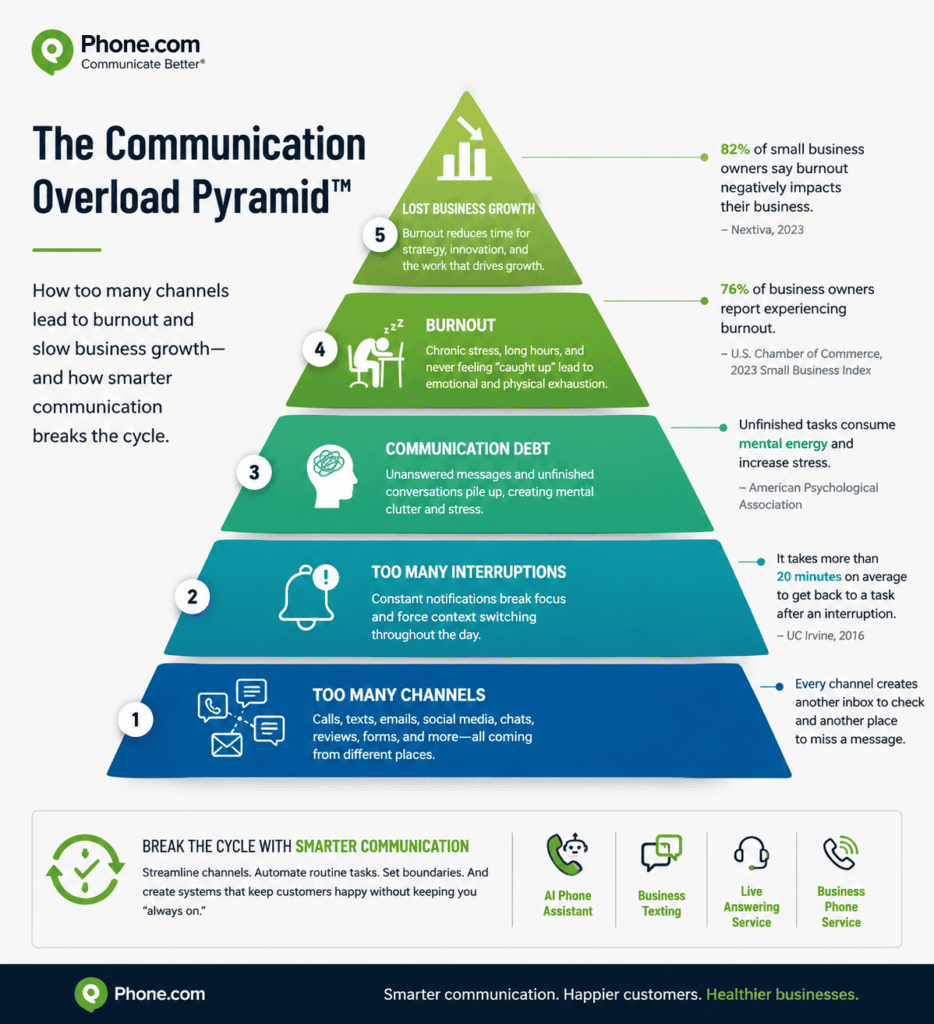
The Hidden Cost of Communication Debt
Most business owners assume being constantly available improves customer service.
Ironically, it often reduces business productivity.
Every unanswered voicemail…
Every unread email…
Every customer text you intend to answer later…
Creates what we think of as communication debt.
Communication debt isn’t the number of messages you receive.
It’s the growing backlog of unfinished mental tasks your brain continues tracking.
Researchers at the American Psychological Association have found that unfinished tasks continue occupying cognitive resources long after you’ve stopped actively working on them. Productivity researchers refer to this as the Zeigarnik Effect—our tendency to remember incomplete work better than completed work.
Like financial debt, communication debt compounds.
The more conversations spread across disconnected tools, the more mental energy is spent simply remembering what still needs attention.
Customer Expectations Have Changed Forever
Customer expectations haven’t become unreasonable.
They’ve adapted to the digital world.
Companies like Amazon, Uber, and DoorDash have normalized:
- Immediate confirmations
- Real-time tracking
- Self-service
- Multiple communication options
- Near-instant responses
Those experiences influence what customers expect from businesses of every size.
According to HubSpot’s State of Customer Service research, customers increasingly expect businesses to respond within hours—not days—and many prefer texting over voicemail for routine interactions.
Salesforce’s State of the Connected Customer report similarly found that customers expect companies to understand their history and communicate consistently across every channel they use.
Small businesses aren’t competing only with their direct competitors anymore.
They’re competing with the communication experience customers receive everywhere else.
Why More Technology Sometimes Makes Things Worse
Ironically, many businesses respond by buying more software.
Another CRM.
Another messaging app.
Another scheduling platform.
Another inbox.
The average business now uses well over 100 SaaS applications, according to BetterCloud’s State of SaaSOps research.
Each one introduces:
- More notifications
- More passwords
- More workflows
- More context switching
Instead of increasing business productivity, disconnected tools often create additional administrative work.
Technology should simplify communication—not multiply it.
Better Systems Create Better Boundaries
Fortunately, the same technology contributing to communication overload can also eliminate much of it.
The goal isn’t to answer every customer immediately.
The goal is to ensure every customer receives a prompt, professional response without requiring you to interrupt your work every time the phone rings.
That’s where integrated communication tools become valuable.
An AI phone assistant can answer routine questions, collect caller information, route calls, and even schedule appointments without requiring constant human attention.
Business Texting gives customers the communication channel they increasingly prefer while keeping conversations centralized instead of scattered across personal phones.
A Live Answering Service ensures important calls are answered professionally, even during busy periods or after hours.
Perhaps most importantly, consolidating customer communication into fewer systems dramatically reduces the mental burden of remembering where every conversation happened.
Six Ways to Reduce Owner Burnout While Improving Business Productivity
Research consistently shows that recovery from professional burnout isn’t about working fewer hours.
It’s about reducing unnecessary cognitive load.
Here are six proven ways to do that:
Consolidate communication tools.
Fewer inboxes mean fewer interruptions.
Set realistic response expectations.
Customers value clarity more than constant availability.
Turn off non-essential notifications.
Research from the APA suggests reducing interruptions improves focus and lowers stress.
Automate repetitive work.
Appointment reminders, FAQs, and call routing are ideal candidates.
Protect your business hours.
Boundaries improve both customer service consistency and long-term sustainability.
Measure responsiveness—not availability.
Fast, predictable communication builds trust.
Being online 24 hours a day does not.
The Businesses That Win Won’t Be the Ones That Work the Most
The future belongs to businesses that communicate more intentionally—not more constantly.
Technology should allow owners to spend less time managing communication and more time serving customers, developing employees, and growing their companies.
Success isn’t about answering every notification.
It’s about designing communication systems that ensure customers always feel heard without requiring business owners to sacrifice every evening, weekend, and vacation.
Because the most valuable resource in any small business isn’t technology.
It’s the owner’s attention.