

A dedicated business phone number is worth the investment for most small businesses.
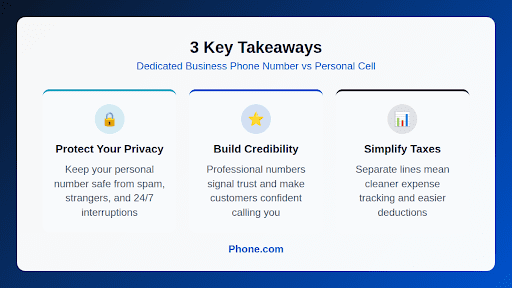
- Using your personal cell for business exposes your private number to spam, strangers, and 24/7 work interruptions.
- Customers trust businesses with professional phone numbers more than those using personal cells.
- A separate business line simplifies tax deductions and expense tracking while meeting compliance requirements in regulated industries.
If you’re mixing personal and business calls on one line, it’s time to make the switch.
Your phone rings. Is it a potential customer ready to sign a contract or your aunt asking about Thanksgiving plans? When you use your personal cell for business, every call becomes a guessing game.
Small business owners often start this way. It feels simpler. One phone, one number, one bill. But as nearly 80% of consumers consider the phone an important channel for communicating with businesses, that “simple” choice starts creating real problems. Missed opportunities. Blurred boundaries. Your personal number spreading across the internet, landing in directories, and eventually finding its way to robocallers.
A dedicated business phone number gives you control over when work calls come through, how customers perceive your company, and what happens to your private information. The question isn’t whether separating business and personal communications makes sense. It’s whether you can afford not to.
Why Does a Dedicated Business Phone Number Matter?
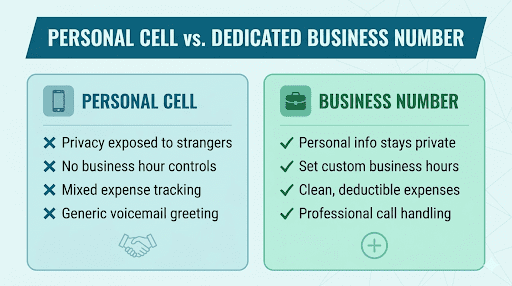
First impressions happen fast. A potential client calling your business forms an opinion before you even answer. They notice whether your caller ID displays a professional business name or an unfamiliar personal number. They hear whether your voicemail greets them with “Thanks for calling ABC Consulting” or a generic “Leave a message after the beep.”
These details signal credibility. A dedicated business phone number tells customers you’re established, organized, and serious about serving them well. Using your personal cell sends a different message, one that can raise doubts about whether your operation is truly professional.
Beyond perception, there are practical realities. Personal phones weren’t designed for business communication. They lack features like call routing to direct customers to the right department, auto-attendants to professionally greet callers, or business hours scheduling to protect your evenings and weekends. You also lose the ability to scale. As your team grows, adding extensions or sharing call responsibilities becomes nearly impossible when everything runs through your personal number.
The distinction between a business line vs personal cell extends to organization as well. When customer calls, personal calls, and spam all arrive on the same device with no way to differentiate them, important business opportunities can slip through the cracks. A virtual business phone number keeps everything categorized and manageable.
5 Key Reasons to Get a Separate Business Phone Number
Making the case for separating your communications comes down to five core benefits that affect your daily operations, professional image, and long-term growth.
1. Protect Your Personal Privacy
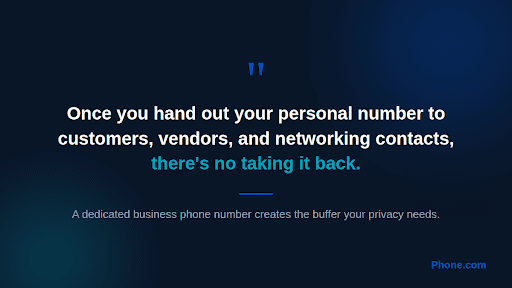
Once you hand out your personal number to customers, vendors, and networking contacts, there’s no taking it back. It ends up on websites, in online directories, and in the databases of telemarketers and spam operations.
A separate business phone number creates a buffer. You can freely share your business line, print it on marketing materials, and list it anywhere customers might search for you, all without exposing your actual personal contact information. If you ever change providers, sell the business, or simply want to disconnect from work, your personal number remains untouched.
Business number privacy also protects your family. Late-night customer calls won’t wake your household. Dissatisfied clients can’t reach you on the number your kids’ school uses for emergencies. You maintain clear boundaries between professional obligations and personal life.
2. Build Instant Credibility
A professional greeting, consistent caller ID displaying your company name, and a dedicated business voicemail all contribute to a polished first impression that builds trust.
Consider the difference between calling a company that answers “Hello?” versus one that greets you with “Thank you for calling Riverside Plumbing, how may I help you?” The second experience immediately communicates competence and organization. According to a 2025 study, 86% of decision-makers across industries agree that the phone remains the most important outbound channel for meeting customer service goals and increasing revenue. Making that channel work effectively starts with having the right phone setup.
3. Establish Work-Life Boundaries
The flexibility of running a small business can become a trap. When your personal phone doubles as your business line, there’s no off switch. Customer calls arrive during dinner, on weekends, and in the middle of your vacation.
A dedicated business phone number changes this dynamic. You can configure business hours so calls route to voicemail after 6 PM and on Sundays. You can silence the business line completely during family time without missing personal calls from friends. Research consistently links clear work-life boundaries to reduced burnout and sustained productivity over time.

4. Access Professional Features
Personal cell phones offer basic calling functionality. Business phone systems provide tools that streamline operations and improve customer experience.
Features like auto-attendants greet callers and direct them to the appropriate person or department. Call forwarding ensures you never miss important calls, whether you’re at your desk, in your car, or working from a coffee shop. Voicemail transcription converts messages to text so you can quickly scan them instead of listening to lengthy recordings. Call recording captures important conversations for training or documentation purposes. None of these capabilities comes standard with a personal cell plan.
Modern business phone systems also integrate with your existing devices. You don’t need separate hardware. The same smartphone you already carry can display your business number for outgoing calls while keeping your personal line private.
5. Scale as You Grow
A personal phone number works for a solo operation. The moment you add a business partner, employee, or virtual assistant, complications arise. How do they answer business calls? How do you transfer customers between team members? How do you track who handled which inquiry?
Business phone systems solve these challenges with extensions, shared lines, and team directories. As your company expands, adding new users takes minutes rather than requiring a complete communication overhaul. You build infrastructure that grows alongside your business instead of limiting it.
Privacy and Security: How Do You Protect Your Personal Information?
Business number privacy deserves deeper examination because the consequences of ignoring it compound over time. Every business card you hand out, every website that lists your contact information, and every customer interaction spreads your number further into the world.
Personal numbers that become business numbers tend to attract unwanted attention. Telemarketers purchase lists from data aggregators. Robocall operations dial every number they can find. Former customers, vendors, or contacts retain access long after your business relationship ends.
A dedicated business phone number contains this exposure. If spam becomes overwhelming, you can change your business number without disrupting your personal contacts. If a dissatisfied customer becomes problematic, your home life remains insulated. The separation creates practical protection that matters more as your business visibility increases.
Security considerations extend to data protection as well. When comparing a business line vs personal cell number, business phone systems typically include features like call encryption, secure voicemail access, and audit trails that personal cell plans lack. For businesses handling sensitive customer information, these protections become essential.
Are There Tax and Financial Organization Benefits?
Small business owners often overlook one practical advantage of a separate business phone number: simplified expense tracking and cleaner tax records.
When you use personal expenses for business, you have to prorate the expense and only deduct the business use portion. So if 30% of your calls are personal, you can only deduct 70% of the phone’s expense. This calculation requires meticulous records of every call, careful documentation of business versus personal usage, and the ongoing burden of separating commingled expenses at tax time.
A dedicated business line eliminates this complexity. The entire cost becomes a straightforward business expense. Your monthly bill goes directly on Schedule C without complicated percentage calculations or usage tracking. During an IRS audit, you have clean documentation showing a separate business line rather than trying to justify partial deductions on a mixed-use personal phone.
This organizational clarity extends beyond taxes. Financial statements become more accurate when communication costs are properly categorized. Budgeting for business expenses becomes simpler when they’re not tangled with personal spending. The administrative burden of running your company decreases when accounts are structured cleanly from the start.
What Are the Compliance Considerations for Regulated Industries?
Certain industries face additional requirements that make a dedicated business phone number necessary. Healthcare providers must comply with HIPAA regulations governing how patient information is communicated and stored. Financial advisors operate under rules requiring documentation of client communications. Legal professionals have ethical obligations regarding client confidentiality.
Personal cell phones rarely meet these compliance standards. Voicemails containing protected health information stored on a personal device create liability. Business conversations on unsecured personal lines may violate regulatory requirements. The informal nature of personal phone usage clashes with documentation and audit requirements.
HIPAA-compliant phone services provide the infrastructure that regulated businesses need. Encrypted communications, secure voicemail storage, Business Associate Agreements, and audit trails demonstrate compliance during inspections. For healthcare providers, attorneys, financial professionals, and others in regulated fields, a proper business phone system is a cost of doing business legally.
What Are the Signs You’re Ready to Make the Switch?
Still wondering whether a separate business phone number makes sense for your situation? Consider these indicators that you’ve outgrown your personal cell for business use.
You hesitate before giving out your number. When networking or meeting potential customers, reluctance to share contact information signals discomfort with how exposed your personal number has become.
Calls regularly interrupt personal time. If business calls arrive during dinner, family events, or vacation, you lack the boundaries a dedicated business line provides.
You’ve missed important business calls because you didn’t recognize the number. When every incoming call looks the same, legitimate customer inquiries compete with spam and personal contacts for your attention.
Your voicemail confuses callers. A generic personal greeting doesn’t serve business callers well, but recording a business message on your personal phone creates awkwardness for friends and family.
Tracking business expenses feels complicated. If separating phone costs at tax time requires spreadsheets and guesswork, a dedicated line simplifies everything.
Frequently Asked Questions
Do I need a second phone to get a dedicated business number? No. Modern business phone systems work through apps on your existing smartphone. Your business number appears on the caller ID for outgoing calls, and incoming business calls ring separately from personal ones. You use one device with two distinct lines.
How much does a dedicated business phone number cost? Costs vary based on features and providers, but many small businesses spend less than they expect. Basic plans start around $15 per month and include features that personal cell plans charge extra for or don’t offer at all. The expense is fully deductible as a business cost.
Can I keep my current personal number for business and add a new personal line instead? You can, but this approach means notifying every personal contact about your new number while customers continue calling the old one. Most businesses find it simpler to add a new business line and keep their personal number unchanged.
What happens if I already gave out my personal number to customers? You can transition gradually. Set up call forwarding from your personal number to your new business line temporarily. Update your marketing materials, website, and business cards with the new number. Over time, customers will adopt the updated contact information.
Make the Smart Choice for Your Business Communications
Running a small business requires countless decisions. Separating your personal and professional communications ranks among the simplest ones to get right. A dedicated business phone number protects your privacy, builds customer trust, simplifies your finances, and provides features that help you serve customers better.
The tools exist to make this transition easy. You don’t need new hardware, complicated installations, or technical expertise. Modern business phone systems run on devices you already own, offer accessible pricing, and can be set up in minutes.
Phone.com offers small businesses the professional communication tools they need without enterprise complexity or pricing. Whether you want a local number that resonates with nearby customers, a toll-free line that projects national reach, or advanced features like auto-attendants and call analytics, the right solution is within reach. Explore plans and pricing to find the perfect fit for your business communication needs.