

When your team is with a customer, working at a jobsite, or finished for the day, who answers the phone?
For small businesses comparing an AI receptionist vs. a live receptionist, the right choice depends on call volume, customer expectations, budget, and how often callers need human judgment. AI can handle routine inquiries and expand coverage. People bring empathy, flexibility, and personal knowledge to more involved conversations.
For many businesses, a hybrid approach is worth considering: use AI for routine requests, overflow, or after-hours calls, and give customers a clear path to a person when they need one.
Key Takeaways
- Match reception to your calls. Repetitive questions and appointment requests have different needs from complaints or sensitive conversations.
- AI can expand availability. An AI receptionist can answer outside business hours and handle supported tasks, depending on the service and configuration.
- Human receptionists offer judgment and empathy. They can interpret unusual situations, coordinate with staff, and adapt to individual customers.
- Compare total costs. Employee compensation, service fees, usage limits, setup, and staff oversight all affect the budget.
- A hybrid approach can balance coverage and personal service. Define when AI should transfer a call and what happens if nobody is available.
Why Small Businesses Need a Reliable Way to Answer Calls
A ringing phone often arrives at an inconvenient time. A salon owner may be with a client. A contractor may be on a ladder. A small professional practice may have everyone in appointments.
Sending calls to voicemail gives customers somewhere to leave a message, but it leaves the next step unfinished. Someone still needs to listen, return the call, and help the customer.
A dependable call-answering strategy should do three things: acknowledge the caller, identify the request, and provide a useful next step. That could mean answering a question, booking an appointment, reaching an employee, or arranging a callback.
Hiring a full-time receptionist is one way to provide that service. AI and outsourced human reception offer other options for teams with different staffing needs.
What Is an AI Receptionist?
An AI receptionist is a call-answering service that uses conversational artificial intelligence to interpret spoken requests and respond according to a business’s information and instructions.
Depending on the provider and setup, an AI answering service may:
- Answer questions about hours, locations, and services.
- Collect caller information and the reason for a call.
- Route callers to an employee or department.
- Schedule appointments through a supported calendar connection.
- Handle calls after hours or when employees are busy.
Unlike a traditional phone menu, a conversational AI phone assistant lets callers describe what they need rather than selecting from numbered options.
Its usefulness depends on the information it can access and the actions it supports. A system that knows your opening hours may answer that question well, but it should not improvise an exception to your refund policy.
Learn more about business communication with an AI phone assistant.
What Do Traditional Receptionists Offer?
Traditional receptionists provide human assistance, whether they work at your location or answer remotely through a live answering service.
A trained person can recognize frustration, ask follow-up questions, and respond to circumstances that do not fit a standard workflow. For example, an existing customer might call to reschedule but also mention a problem with the previous visit. A person can address both needs and decide who should follow up.
There are two main ways to obtain human coverage:
- An in-house receptionist works directly with your team and may also greet visitors, manage office tasks, and coordinate with employees.
- A live answering service provides remote reception under an agreed service plan. Its staff can follow your instructions, take messages, and transfer calls within the service’s capabilities.
An outsourced receptionist may have less knowledge of your business than an employee. Clear scripts, current information, and escalation instructions matter for both.
Phone.com’s guide explains how a live answering service can work for a small business.
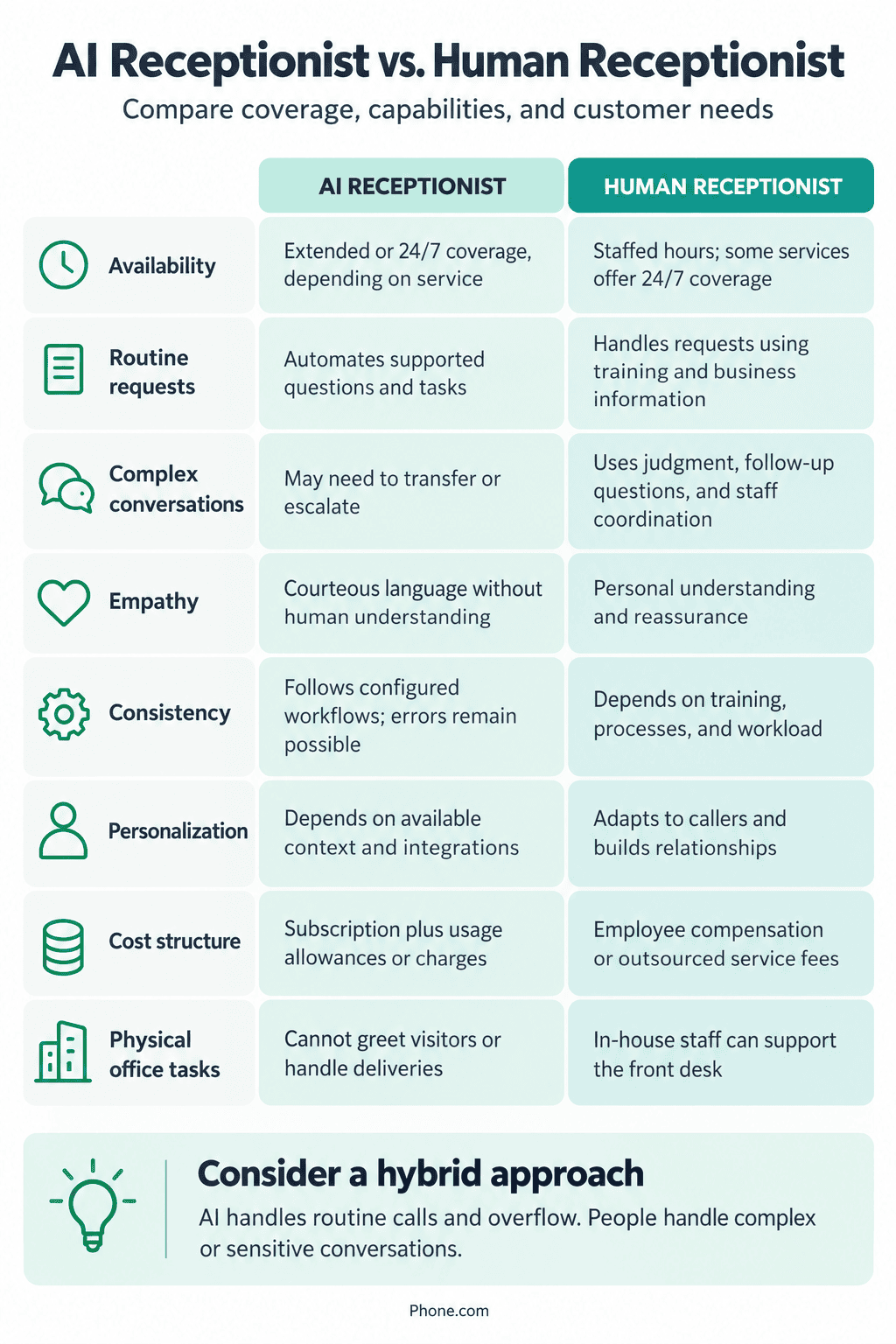
AI Receptionist vs Live Receptionist
Neither option automatically delivers a good customer experience. An inaccurate AI answer and a poorly handled human transfer can both frustrate callers. Evaluate how the complete call flow works.
How Much Does Each Option Cost?
Compare the cost of meeting the same coverage needs and completing the same tasks. An employee who manages visitors and office administration does more than a service that only answers calls.
In-house receptionist costs
The U.S. Bureau of Labor Statistics receptionist overview reports a median hourly wage of $18.27 in May 2025. This is a national benchmark, rather than a local hiring quote or a fully loaded staffing cost.
Your budget should also account for applicable payroll taxes, benefits, recruiting, training, and coverage during breaks or absences.
Outsourced live receptionist costs
Live answering services may charge by subscription, minutes, calls, or a combination. Compare included usage, additional usage rates, coverage hours, and charges for tasks such as appointment scheduling.
Ask how transfers are billed and whether the service can support your expected busiest periods.
AI receptionist costs
AI services may combine a monthly subscription with usage allowances and additional charges. Review setup fees, integrations, supported tasks, and any required business phone plan.
Include staff time for maintaining business information and checking performance. Automation still needs an owner.
A useful comparison is:
Total monthly cost = fixed fees + usage charges + staffing and oversight + setup costs spread over the expected service period.
Evaluate the outcome alongside the price: Can callers complete their request, reach the right person, or get a dependable callback?
Which Businesses Benefit From Each Option?
Start with the type of conversation, even when businesses share the same industry.
AI may be useful when a large share of calls involve recurring questions, straightforward appointment requests, or routing. A salon might use it to answer questions about hours and book supported appointment types. A home service company might use it to collect inquiries while technicians are working.
Human reception may be especially valuable when callers need reassurance, exceptions, detailed coordination, or a conversation about a sensitive issue. A law firm may want a person to handle distressed prospective clients. A professional practice may need staff to interpret an unusual request before deciding what happens next.
These are illustrative use cases. A single business can receive both routine and complex calls throughout the day.
Why a Hybrid Reception Strategy May Work Best
A hybrid reception strategy assigns routine work to automation while preserving access to people.
Consider this illustrative workflow for a home service business:
-
AI answers the call and asks what the customer needs.
-
It handles a supported routine request, such as sharing service hours or offering an appointment.
-
It identifies requests that need staff, such as a complaint, an exception, or an issue outside its instructions.
-
It transfers or escalates the call according to the business’s rules, passing along collected details where supported.
-
A person takes over and helps the customer resolve the issue.
Another option is to let your receptionist answer first and use AI only for overflow or after-hours calls.
The handoff deserves as much attention as the greeting. Define who receives transferred calls, what information they receive, and what happens when nobody answers. If the next step is a callback, set a response window your team can meet.
The National Institute of Standards and Technology’s AI Risk Management Framework provides guidance for evaluating and managing AI risks. Applied to reception, a practical approach is to test real caller scenarios, review mistakes, and update instructions as your business changes.
Insights From Phone.com
Having served more than 50,000 small businesses, Phone.com’s perspective is practical: useful features should make communication easier for customers and employees.
Start with the moments when your team struggles to answer. Do calls arrive while employees are serving customers? Do routine questions interrupt focused work? Do people need appointments after closing?
Phone.com AI Receptionist supports 24/7 answering, call routing, answers based on your business knowledge, and appointment scheduling with Google or Outlook calendars. The way you configure those capabilities should reflect the calls your business receives.
Evaluate onboarding and ongoing support alongside features. Your team should be comfortable updating information and managing the next step when a caller needs personal assistance.
How to Choose the Right Receptionist Solution
Review a representative period of calls, including busy days and after-hours activity. Use these questions to compare options:
- How many calls do we receive, and when do they arrive?
- Which questions or requests repeat most often?
- Which conversations require human judgment or empathy?
- Do we need appointment scheduling, lead capture, or both?
- Can callers request a person, and where does that call go?
- What happens if a transfer fails or an employee is unavailable?
- What is the total cost at our expected usage, including busy periods?
- Who will maintain information, review issues, and manage follow-up?
- Can coverage and routing change as the business grows?
Before committing, test the full experience. Try a routine question, an unusual request, a request for a person, and a call outside business hours.
Track completed appointments, successful transfers, abandoned calls, callback follow-through, and customer feedback. A call being answered is useful; the customer reaching a workable next step is the stronger measure.
Choose the Coverage Your Customers Need
AI receptionists and traditional receptionists serve overlapping needs in different ways. AI can expand availability and handle routine work. People remain valuable for sensitive conversations, unexpected requests, and personal service.
Choose the combination that helps customers get appropriate assistance when they call. For some businesses, that will mean human reception with automated backup. For others, AI can answer first and bring in staff when needed.
Explore Phone.com AI Receptionist to see how automated answering, routing, and scheduling could fit your business.
FAQs
What is the difference between an AI receptionist and a live receptionist?
An AI receptionist uses software to interpret spoken requests and complete supported tasks. A live receptionist is a person who answers calls, asks questions, and uses training and judgment to assist the caller. Both depend on accurate business information and clear processes.
Is an AI receptionist cheaper than hiring a receptionist?
It can cost less for routine phone coverage, but the comparison depends on usage, service fees, staffing needs, and the tasks involved. An employee may also handle visitors and office administration. Compare total costs for the work and coverage you actually need.
Can an AI receptionist replace a traditional receptionist?
An AI receptionist can take over some call-answering tasks. It cannot replace every part of an in-house receptionist’s role, including physical front-desk duties, nuanced coordination, and human judgment. Many businesses can use AI to support their staff.
Can AI receptionists answer calls after business hours?
Many AI receptionist services can answer around the clock. What they can accomplish after hours depends on their configuration and integrations. Establish a clear process for requests that require a person when staff are unavailable.
Can a small business use AI and human receptionists together?
Yes. AI can handle routine calls, overflow, or after-hours coverage while employees or a live answering service handle more complex conversations. Confirm transfer capabilities, available context, and backup procedures before relying on the combined workflow.